Introduction: The Growing Complexity of Automotive Systems
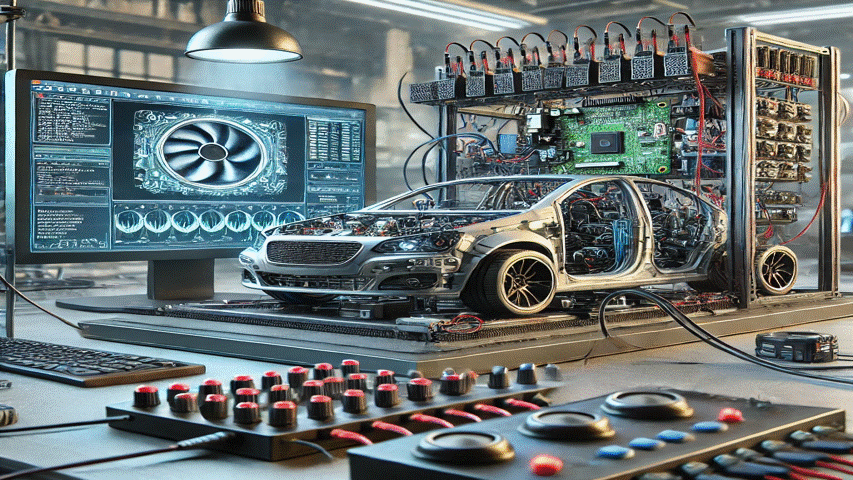
As the automotive industry transitions into a new era defined by autonomous vehicles (AVs), electric vehicles (EVs), and connected cars, the demand for rigorous system validation has reached unprecedented levels. Traditional validation methods struggle to keep up with the complexity and scale of modern automotive systems, creating a need for innovative solutions like Hardware-in-the-Loop (HIL) Testing. HIL Testing has become the cornerstone of system validation, enabling engineers to simulate real-world conditions and test critical components without relying on costly physical prototypes. barriers and taking leadership roles in this challenging industry.
From heading manufacturing plants to designing next-generation electric vehicles, women are redefining what it means to work in the automotive sector.
The Problem: Why Traditional Validation Falls Short
In a world where systems are interconnected and safety-critical, testing methods must evolve. Traditional
validation approaches are often:
• Time-consuming: Physical prototypes require significant resources and time to build and modify.
• Costly: The expense of creating prototypes for iterative testing is not sustainable.
• Limited: Real-world edge cases and scenarios are hard to replicate without advanced tools.
These limitations make traditional methods inadequate for the modern automotive landscape, especially with
the
rise of electric drivetrains and advanced driver assistance systems (ADAS).
The Solution: HIL Testing as a Game-Changer
Hardware-in-the-Loop (HIL) Testing addresses these challenges by offering a flexible, cost-effective, and
efficient way to validate complex systems.
• Real-Time Simulation: HIL Testing allows engineers to simulate real-world scenarios and stress-test
components
like ECUs (Electronic Control Units) under controlled conditions.
• Risk Reduction: Critical safety systems, such as braking algorithms in autonomous vehicles, can be
rigorously
tested without physical risks.
• Iterative Development: Engineers can modify and test software components in real-time, accelerating the
development cycle.
Why HIL Testing is a Game-Changer
Accelerates Development: Tests can begin before the physical prototype is ready.
Cost Efficiency: Eliminates the need for expensive physical test setups.
Safety for Critical Systems: Safely validates ADAS or EV systems under extreme scenarios.
Real-Time Testing: Simulates real-world conditions dynamically for precise validation.
Scalable Validation: Tests individual components and their integration in complex systems.
Tools and Technologies Powering HIL Testing
To perform HIL Testing effectively, engineers rely on industry-standard tools and technologies,
including:
• dSPACE: For real-time simulation and model-based development.
• NI Veristand: For integrating HIL setups with hardware and software components.
• Vector Tools: Such as CANalyzer and CANoe, for communication protocol testing.
Mastery of these tools is essential for any engineer aiming to excel in HIL Testing roles.
Real-World Applications of HIL Testing
HIL Testing plays a critical role in validating systems for:
1. Autonomous Vehicles: Testing ADAS features like lane-keeping assist, adaptive cruise control, and
emergency
braking under simulated conditions.
2. Electric Vehicles: Validating Battery Management Systems (BMS) and powertrain components to ensure safety
and
efficiency.
3. Connected Cars: Ensuring seamless communication between IoT-enabled devices and vehicle control
units.
For example, Tesla uses HIL Testing to validate its Autopilot systems, ensuring safety and reliability in
real-world driving conditions.
Key Skills for Engineers in HIL Testing
To excel in HIL Testing, engineers need:
• Proficiency in Python automation for scripting test scenarios.
• Hands-on experience with tools like dSPACE, NI Veristand, and CANalyzer.
• A strong understanding of embedded systems and communication protocols (CAN, LIN, FlexRay).
• Knowledge of ISO 26262 functional safety standards for validating safety-critical systems.
Why HIL Testing is the Future of Automotive Validation
The global shift toward software-defined vehicles (SDVs) has made HIL Testing indispensable. By enabling faster, safer, and more cost-effective system validation, HIL Testing is set to revolutionize the way the automotive industry approaches product development and quality assurance. According to industry reports, the market for HIL Testing solutions is projected to grow by 12% annually, reflecting its increasing adoption by automotive leaders like Bosch, Continental, and Tesla.
How DPIT Systems Can Help You Excel in HIL Testing
As the demand for HIL Test Engineers grows, acquiring the right skills has never been more critical. At DPIT
Systems, our HIL Testing and Automation with Python course provides comprehensive training in:
• Setting up and executing HIL simulations using dSPACE and NI Veristand.
• Automating test scenarios with Python scripting.
• Mastering communication protocols like CAN, LIN, and FlexRay.
• Working on real-world projects to validate components for EVs and AVs.
With hands-on training and guidance from industry experts, you’ll be equipped to thrive in this high-demand
field.
Take the First Step Toward Your Career in HIL Testing
Explore how DPIT Systems can help you master the tools and techniques needed to excel in HIL Testing. Join our program today and prepare for a future at the forefront of automotive system validation.
[Explore Our HIL Testing Program >>]